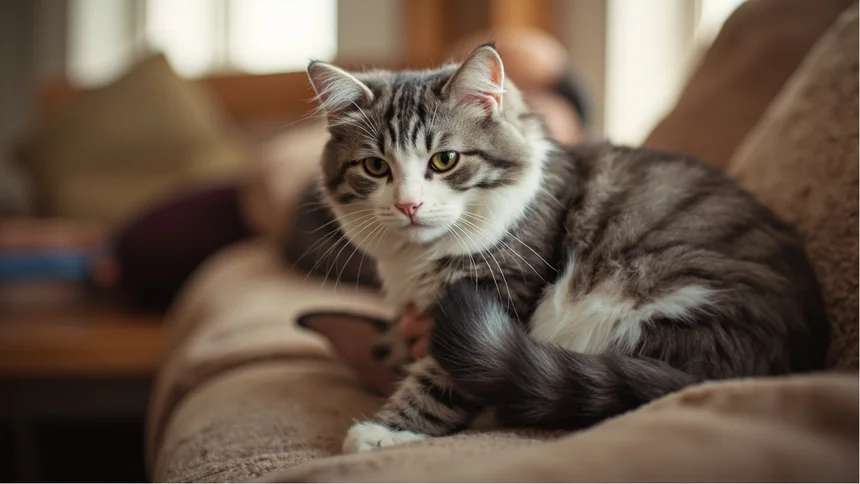
You are sitting on the couch, hand moving steadily across your cat’s back. Everything seems fine. Then, without warning, teeth sink into your hand. No hissing, no obvious buildup. Just a sudden chomp that leaves you confused and your cat apparently unbothered.
If this has happened to you, take comfort in knowing you are far from alone. This pattern — a cat appearing calm and then biting during otherwise gentle petting — has a name: petting-induced aggression, sometimes called feline overstimulation aggression. It is one of the most common behavior complaints cat owners bring to veterinarians and behaviorists.
The really important thing to understand is that your cat was almost certainly giving you signals the entire time. You just were not sure what to look for. Once you learn the early warning signs, most of these bites become completely preventable.
What Your Cat’s Body Is Telling You Before the Bite
Cats almost never bite without a buildup. By the time the teeth make contact, your cat has spent seconds or even a full minute signaling discomfort. These signals are easy to miss because they are subtle, especially compared to the dramatic warning displays dogs give. Here are the signs that almost always appear before a petting-induced bite.
Tail flicking or lashing. A still, relaxed tail can start moving in quick, sharp jerks the moment your cat is approaching his threshold. This is one of the earliest and most reliable indicators that the petting session should end. Tail flicking during petting-induced aggression is so common that ASPCA behavior guides list it as a near-primary warning sign.
Ears rotating, flattening, or swiveling backward. Ears that suddenly turn sideways, flatten against the head, or flick backward mid-stroke are your cat’s way of saying the touching has gone on long enough. Normal forward-facing ears show curiosity; ears that change position show rising discomfort.
Rapid dilation of the pupils. Cats normally have slit pupils in good lighting. When those pupils suddenly round out and widen during petting, it often signals that your cat’s nervous system is shifting from relaxed to aroused. Wide pupils under normal indoor lighting are a meaningful signal, not just a trick of the light.
Skin rippling along the back. Sometimes called “twitching,” this looks like a wave passing under the fur. It is an involuntary response to sensory overload and is a direct precursor to biting in many cats. If you feel or see this happening, stop immediately.
The head turn. Your cat quickly turns his head toward your hand. This is one of the clearest signals your cat is deciding whether to use his mouth. He is tracking your hand, assessing proximity, and preparing a response. This is the last checkpoint before a bite lands.
Why Cats Bite During Petting: The Neuroscience Behind It
You might assume your cat bites because he is mean, or because he does not like you. Neither is true. The real explanation lives in how a cat’s nervous system processes sustained touch.
A cat’s fur is densely packed with nerve endings. Each stroke sends a cascade of sensory signals to the brain. What starts as pleasant can accumulate into neurological overload if the petting goes on too long, covers the wrong area, or involves too much pressure. The point at which pleasant becomes aversive varies enormously between individual cats — some tolerate five minutes of belly rubs, others hit their limit after thirty seconds of back stroking.

When the threshold is crossed, the only remaining option for a cat is to use his teeth. This is not a behavioral problem your cat is choosing to have. It is a sensory response his body is having. The goal of management is not to fix your cat — it is to learn where his threshold sits and stay on the safe side of it.
Petting-Induced Aggression vs. Fear-Based Biting
Not every cat bite comes from overstimulation. Cats also bite out of fear, pain, or redirected aggression, and these require different responses. Knowing which one you are dealing with matters enormously.
A cat who bites from petting-induced overstimulation will usually show the signs described above — tail flicking, ear changes, skin rippling — and will often bite while still in contact with you, without much of a retreat. The sequence is typically: still and relaxed, then subtle warnings, then a nip.
A cat biting from fear or pain will show a very different body language picture. Flattened ears pressed hard against the skull, large dilated pupils, a low or tucked tail, crouching low to the ground, hissing or growling — these are fear signals. A frightened cat bites because he feels cornered and cannot escape the situation any other way. These bites are often more severe than those from overstimulation, because the cat is in genuine defensive mode rather than simply trying to communicate.
If your cat has always been gentle during petting and suddenly starts biting with no warning signals, that is a different situation altogether — more on that below.
How to Prevent the Bite Without Losing the Bond
The goal is not to stop petting your cat. It is to pet him within his comfort zone so that each interaction ends on a positive note. Positive interactions build trust; bites erode it. Every nip that lands makes your cat slightly more likely to bite again in the future.
Keep sessions short and watch for the first signal. If you know your cat tends to hit his limit after about two minutes of petting, stop at one minute. Stopping while things are still good means your cat associates petting with something pleasant ending on a high note. This makes him more likely to seek out attention again rather than avoiding it.
Respect the no-zones. Most cats have specific areas they tolerate well and areas that consistently trigger irritation. The belly, lower back, and base of the tail are frequent trouble spots. Head and chin scratches, on the other hand, tend to be better tolerated across more cats. Watch where your individual cat seems most relaxed and focus your attention there.
Never use your hands as toys. This is one of the most important pieces of advice from the ASPCA and veterinary behaviorists. If you wiggle your fingers for your cat to chase, or let him attack your hand during play, you are teaching him that human hands are prey. Use wand toys or teaser toys instead. This keeps your hands free of teeth and gives your cat a proper outlet for his hunting instincts.
Let your cat initiate contact. Cats who choose to climb into your lap or press their head against your hand are actively inviting interaction. This is a much better foundation than reaching for a cat who is asleep or hiding. An invited interaction has a lower bite risk from the start.
What to Do If the Bite Lands
If a bite happens despite your best efforts, do not punish your cat. Yelling, swatting, or spritzing with water will make things worse, not better. A punished cat does not learn that biting is wrong — he learns that his owner is unpredictable and frightening. Fear-based aggression is harder to treat than overstimulation-based biting, so introducing fear into the relationship creates a much more serious problem.
The correct response is simple: go still, do not pull away sharply (this can trigger more biting), and remove your hand calmly. If your cat remains agitated, stand up slowly and walk away, giving him space to settle. When he is visibly relaxed — not just frozen — you can try interacting again, ideally with a toy rather than your hands.
When to Call Your Veterinarian
One scenario deserves special attention. If a cat who has always been tolerant of petting suddenly begins biting with no warning signals, or if the biting is paired with other changes — a drop in appetite, missing the litter box, hiding more than usual, grooming excessively — schedule a veterinary appointment before assuming it is a behavioral issue.
Several medical conditions can cause a normally gentle cat to become aggressive. Hyperthyroidism, degenerative joint disease, dental pain, and early-stage cognitive decline in senior cats are all documented causes of new-onset aggression. Pain makes any animal irritable. A cat with arthritic hips may bite when his lower back is touched simply because it hurts. Your veterinarian can rule out or identify these conditions before you treat the behavior.
Once medical causes are cleared, a certified animal behaviorist (DACVB) can help with persistent or complex aggression cases that do not respond to environmental management alone.
Reading the Signals Is a Skill Worth Building
Most cat bites are not random acts of feline hostility. They are the final move in a communication sequence the cat has been running the entire time. Once you learn what those early signals look like — tail flicks, ear rotations, pupil changes, skin ripples, the quick head turn — you gain something valuable: the ability to stop before the bite lands, every single time.
Ignoring the warning signs does not make them go away. It makes the bites more likely, and it can push a cat from occasional nips into more serious aggressive patterns. Respecting those signals does not mean your cat is in control or that you are giving in. It means you are paying attention to what your cat is actually saying.
And that attention is the foundation of everything that makes living with a cat worthwhile.