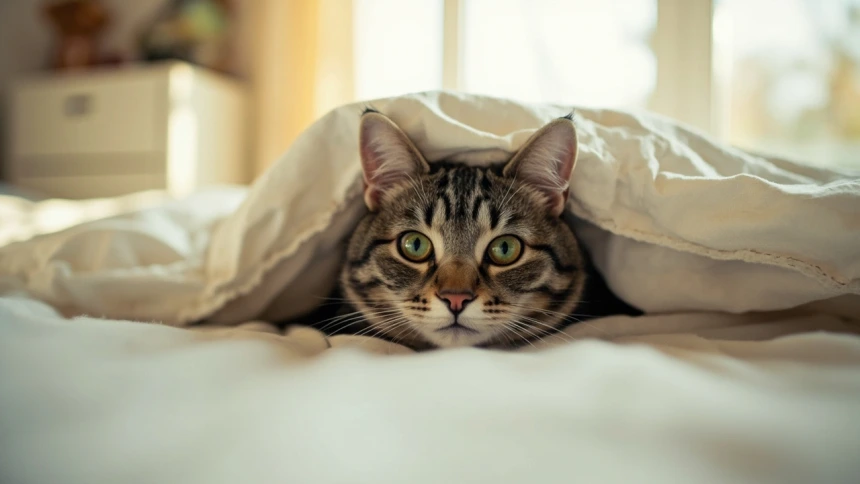
Three days after my friend adopted a rescue cat, the cat vanished. Not escaped—vanished. She searched the apartment for hours before finally spotting a pair of eyes peering out from inside the closet wall. The cat had squeezed into a gap behind the drywall where no one would ever think to look.
Cats do not hide because they are being difficult. They hide because something in their environment is telling them it is not safe to be visible. Understanding that one fact changes everything about how you respond to a cat who disappears under the bed every time the doorbell rings or retreats for days after a minor household change.
What Hiding Actually Means

Hiding is a coping mechanism, not a personality trait. When a cat feels threatened, overwhelmed, or uncertain, the instinct to disappear is not weakness or misbehavior—it is survival wiring. Even cats who seem confident in familiar spaces can retreat suddenly when something shifts: a new piece of furniture, a repairman at the door, a stray cat outside the window, or a change in your daily routine.
The length of hiding episodes tells you something useful. A cat who comes out after an hour is processing a minor stress. A cat who stays hidden for days may be dealing with something more serious—pain, illness, or significant environmental disruption. Prolonged hiding in cats is worth taking seriously, especially when it represents a change from their normal behavior patterns.
Medical Problems First
Before you assume your cat is stressed or scared, you need to rule out pain or illness. Cats are masters at hiding disease, and one of the clearest signs that something is wrong is a sudden increase in hiding behavior. A cat who normally greets you at the door but now disappears under the bed for hours may be telling you something is physically wrong. Cats instinctively hide illness because in the wild, appearing weak makes them vulnerable to predators.
Conditions that commonly cause hiding include urinary tract infections, dental pain, arthritis in older cats, digestive issues, respiratory infections, and hyperthyroidism. If your cat is hiding more than usual and you cannot identify an obvious environmental cause, a veterinary visit is the right first step. Do not wait to see if it passes. Cats are also experts at compensating for pain in subtle ways—you may not notice limping or stiffness until the condition is advanced.
Environmental Triggers
Cats are creatures of routine, and small changes can feel large to them. A new cat in the neighborhood outside your window can keep your indoor cat in hiding for days. Construction noise, a baby crying in a neighboring apartment, a change in your work schedule that leaves your cat alone more hours, even a new air freshener or cleaning product can shift a cat’s sense of safety in ways that seem disproportionate to us but make complete sense to them.
The key is observing what happens right before the hiding starts. If you can identify the trigger, you can either remove it or help your cat desensitize to it gradually. Blocking visual access to frightening outdoor views—using curtains, blinds, or window film—can reduce stress significantly for indoor-only cats. Cats who can see other cats patrolling their territory but cannot do anything about it experience chronic frustration that often manifests as increased hiding.
Resource Competition in Multi-Cat Homes
In households with multiple cats, hiding can be a sign that one cat is dominating resources and another is feeling squeezed out. This does not always look like obvious aggression. A calm, confident cat who simply blocks access to the litter box, the food bowl, or the sunny window spot can create chronic low-level stress that shows up as hiding in the less favored cat. The dominant cat does not even need to be aggressive—simply being present and controlling space is enough.
The rule for multi-cat homes is simple: one of everything per cat, plus one extra. Two cats need three litter boxes, three water bowls in different locations, multiple resting areas at different heights, and several scratching posts. Resources spread throughout the home rather than clustered in one corner give every cat options without having to pass through another cat’s territory or feel trapped in a single location.
How to Help a Hiding Cat Feel Safe Again
Start by not chasing them. Every time you pull a hiding cat out, carry them around, or force interaction, you confirm their fear that the world is not safe. Forcing contact when a cat is frightened teaches them that you are unpredictable and that hiding was the right instinct. Instead, sit quietly near their hiding spot without demanding anything. Read a book. Work on your laptop. Let them come out on their own schedule. Your calm, unhurried presence is the message.
Food is your best reconnection tool. Set small amounts of something high-value near the edge of their hiding space. Do not put it inside the hiding spot—put it close enough that they can reach it without fully emerging. Wet food, chicken baby food without onion or garlic, or a favorite treat all work well. Let them eat in peace without staring at them. Over several days, slowly move the food slightly closer to where you are sitting. The goal is to reconnect positive experiences with your presence, not to rush the process.
Vertical space helps enormously. Cat trees, wall shelves, and window perches give cats elevated spots where they feel more secure. A cat who can watch the room from above feels less vulnerable than one on the floor with no escape route. Place a comfortable bed or blanket on a high shelf and let your cat discover it on their own terms. Cats feel safest when they have somewhere high to retreat to when they need to observe or escape.
Pheromone diffusers like Feliway can support a stressed cat, though they work best alongside environmental changes rather than as a standalone fix. Think of them as a tool that makes the other adjustments more effective, not a solution by themselves. Plug diffusers in the room where your cat spends the most time and in rooms where hiding frequently occurs.
When Hiding Becomes a Welfare Problem
Some cats hide so much they are essentially living parallel lives in your home—appearing only at night when no one is watching, avoiding all interaction, and showing signs of chronic stress like over-grooming or excessive meowing. This is not a training problem. This is a welfare problem that deserves serious attention. A cat who cannot feel safe enough to be present in their own home is not having a good life, regardless of how well they are fed.
If your cat hides most of the day, stops eating or eating in front of people, eliminates outside the box when they normally would not, or shows any sign of prolonged distress, call your veterinarian. Behavior problems that look like personality issues are often the first visible sign of pain, infection, or chronic illness that has gone undetected. Cats who seem aloof or independent by nature are sometimes that way because they feel unwell and no one has noticed.
The cats who hide the most are often the ones who need us the most. Learning to read the signals, remove the triggers, and create a home where your cat feels genuinely safe is not just good for your cat. It is the foundation of a relationship worth having—one where your cat chooses to come out and be with you, not just tolerates your existence from a distance.