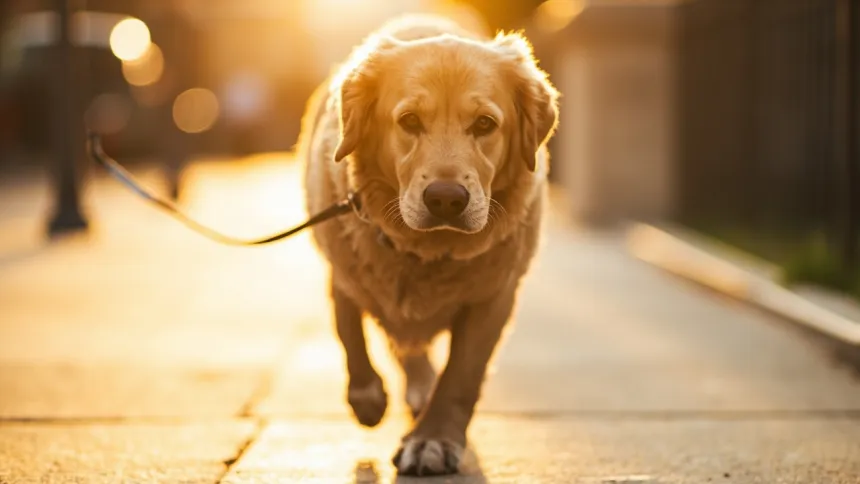
Your arm is fully extended. Your shoulder is starting to ache. And your dog is twenty feet ahead of you, completely unbothered, sniffing a fire hydrant like that is exactly where he intended to be all along.
Sound familiar?
Loose leash walking is one of the most sought-after skills in dog training — and also one of the most misunderstood. Most owners reach for a choke chain or prong collar because they assume the problem is that their dog does not respect them. But here is the uncomfortable truth: those tools do not teach your dog to walk nicely. They just make pulling feel worse.
So what is the actual fix? Keep reading.
Why Dogs Pull in the First Place
Dogs pull because it works. That is the whole story, really.
Every time your dog lunges forward and you follow — even for a few steps — you have just reinforced the behavior. The leash goes tight, you move toward whatever your dog wanted, and the tension releases. To your dog, tight leash equals forward movement. And forward movement is what he wants.
This is called an accidental reinforcement history, and it is not your dog fault. It is not stubbornness or dominance. It is just biology: dogs repeat actions that produce results.
The second reason pulling feels inevitable is that most dogs have never been shown what you actually want them to do instead. They are not psychic. If the only thing you have ever done is yank back when they pull, they have learned that pulling equals tension AND equals eventual movement. They have learned nothing about what a loose leash actually means.
The Red Light/Green Light Game (Your New Best Friend)
The single most effective technique for loose leash walking does not involve any equipment at all. It is called the Red Light/Green Light exercise, and trainers at the San Diego Humane Society swear by it.
Here is how it works. Start in a low-distraction area — your living room or a quiet corner of your yard. Take a few small treats and put them on the ground a few feet in front of you. Hold your dog leash with the slack between you loose.
When your dog is standing or walking beside you with zero tension on the leash, say yes! and move forward toward the treats. When your dog pulls and the leash goes tight — even slightly — stop immediately. Do not yank. Do not tug. Just freeze in place.
Stand still and wait. Treats on the ground, dog at the end of the leash, total stillness.
Eventually your dog will turn back toward you or the tension will ease. The moment the leash goes slack again, you start walking. If he pulls again, you freeze again.
The logic is simple: reaching the treats requires a loose leash. Pulling does not get your dog there any faster — it actually stops the whole game. Your dog figures this out surprisingly quickly when you are consistent.
Practice this for five to ten minutes a day in a calm environment before ever taking it on a real walk. The goal is for your dog to understand the rule before you introduce the chaos of the outside world.

Change Direction Without Saying a Word
Once your dog has the basic Red Light/Green Light idea, you can add a second layer: direction changes.
Every time your dog hits the end of the leash and pulls, simply turn around and walk the other direction. No verbal cues. No heel. No stern commands. Just a quiet, calm 180-degree pivot.
Why does this work? Because your dog was heading toward something. By reversing course, you have made the thing he wanted less accessible. And you have done it without any confrontation or punishment.
Zak George, a well-known positive reinforcement trainer, demonstrates this technique in several of his videos. The key is to change direction BEFORE your dog hits the end of the leash — at the very first sign of tension, not after. The moment you feel the leash load up with weight, pivot.
Most dogs adapt to this within a few sessions. They start paying attention to where you are going, not just where they want to go.
Equipment That Helps Without Hurting
There are a few tools that can support your training without relying on pain or intimidation.
A front-clip harness attaches the leash to a ring on the chest rather than the back. When your dog pulls, the harness naturally redirects his body to the side rather than forward. It is not a magic fix — it will not teach him to stop pulling on its own — but it makes the learning process less frustrating for both of you.
A long line — typically 15 to 30 feet — is another tool trainers recommend during the early stages. It gives your dog more freedom to explore while still keeping him under your control. You can let out more leash when he is walking well and keep it shorter when he starts pulling. The extra length also lets you practice recalls during walks, which reinforces the connection between you and your dog.
What you should avoid: choke chains, prong collars, and shock collars. The San Diego Humane Society explicitly advises against aversive collars. They may suppress pulling in the short term through fear or pain, but they create a negative association with the walk itself, and they can cause real physical injury — especially in small dogs or dogs with delicate tracheas.

Set Your Dog Up to Succeed in the Real World
The number one reason loose leash training fails in practice is that owners try to train in environments that are simply too hard for their dog current skill level.
If your dog can barely walk past another dog without losing his mind, you cannot expect him to walk calmly past that dog on a six-foot leash. That is not a training problem — that is an environment management problem.
The fix is deceptively simple: practice at a distance from distractions where your dog can actually succeed. Walk past the dog park from across the street. Walk past the fire hydrant at a wide berth. Work up to harder environments gradually, just like you would with any other skill.
When your dog genuinely encounters something overwhelming and cannot help pulling, do not fight him. Just change direction. That is not failure — that is using the tool you already have.
Common Mistakes That Keep Pulling Alive
Even with good intentions, most owners accidentally reinforce pulling in a few predictable ways.
Following your dog when he pulls is the obvious one — but the subtler mistake is following him even one or two steps. Every step you take into tension tells your dog that tension eventually leads to forward movement.
Another common error is letting the leash go completely slack when the walk is going well, then grabbing it tight when your dog starts to pull. This inconsistency sends mixed signals. A calm, consistent leash feel throughout the walk is better than a reactive grip.
And finally, be careful with verbal cues like heel or walk nice if your dog has not actually been trained to understand them. Saying heel over and over while your dog ignores it does not train anything — it just teaches him that those words do not require a response.
Building Duration and Distance
Once your dog can walk calmly on a short leash in your living room, it is time to stretch the criteria. Increase the distance to the treat pile. Walk further between stops. Practice in your front yard, then a quiet sidewalk, then a mildly busy street.
Each new environment is essentially a new training session. Your dog may regress. That is completely normal. Simply drop back to an easier version of the exercise — shorter distance, quieter location, higher rate of reinforcement — and build up again.
The dogs who eventually walk beautifully in any environment are the ones who were patient enough to build the skill in small steps over time. There is no shortcut that replaces consistency.
Your dog is not pulling to annoy you. He is pulling because at some point, it accidentally worked. The good news is that dogs are extraordinarily good at learning new rules when those rules are consistent and the alternative is clearly rewarded.
Red Light/Green Light teaches your dog that loose leash equals forward movement and pulling equals full stop. Direction changes teach him to pay attention to where you are going. A front-clip harness and a long line give you tools that support rather than suppress.
The only things that do not work? Choke chains, prong collars, and expecting your dog to figure it out through sheer willpower.
You have got this. And so does your dog.