Last month a reader told me her 13-year-old Labrador stood at the wrong side of the back door one evening — the same door she had used for eleven years. The dog simply could not figure out which way to push it open. That small moment broke her heart, and it is exactly the kind of scene veterinarians hear about every single week.
If your senior dog has been acting strangely — getting lost in familiar rooms, waking you up at 3 a.m. with restless pacing, or suddenly seeming to forget the people she has known her whole life — you are not imagining it. Something real is happening inside her brain, and it has a name: canine cognitive dysfunction, or CCD. Think of it as your dog’s version of Alzheimer’s disease.
What Is Canine Cognitive Dysfunction, Exactly?
CCD is a slow, progressive condition caused by physical changes in an aging dog’s brain. Over time, a protein called beta-amyloid builds up and forms plaques on the brain. These plaques interfere with the signals passing between brain cells, called neurons. Neurons gradually become dysfunctional, disrupting memory, learning, and spatial awareness. Blood flow to the brain also decreases with age, making everything work more slowly.
Unlike a sudden infection or injury, CCD does not appear overnight. It creeps in over months and years, which is why the early signs are so easy to miss or dismiss as normal old age. Dogs do not wake up one morning suddenly confused — the changes are subtle at first and then slowly accumulate.
The DISHAA Checklist: Recognizing Every Sign
Veterinary behaviorists use the acronym DISHAA to organize the signs of cognitive decline in senior dogs. It covers everything from disorientation to anxiety, and seeing the full list often helps owners connect dots they had been noticing for months without knowing they were related.
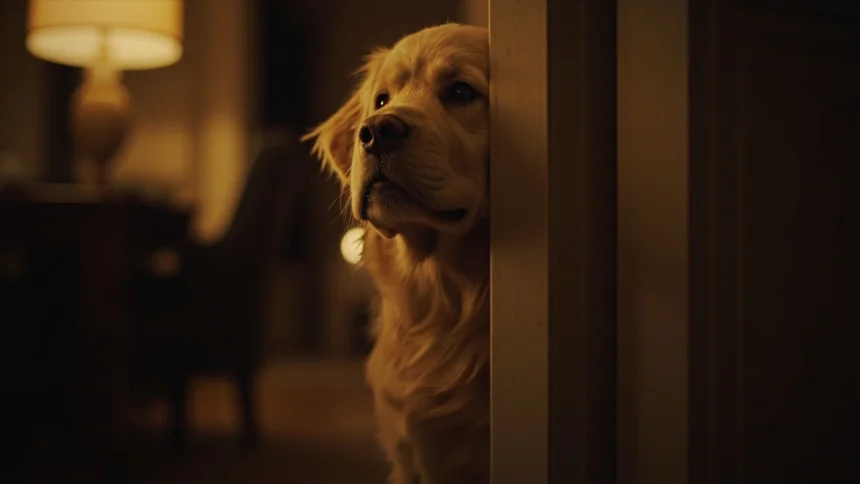
Disorientation is one of the most recognizable signals. A dog may get lost in rooms she knows perfectly well, go to the wrong side of a familiar door, or stare blankly at walls. She might walk into corners or behind furniture and just stand there, unable to figure out how to back out. Some dogs fail to recognize family members or other pets in the household.
Interactions with people and other animals often change noticeably. Previously affectionate dogs may become withdrawn and aloof. Others do the opposite — they become clingy and anxious the moment you leave the room. Some dogs develop sudden irritability and snap or growl when approached, even by people they love.
Sleep-wake cycle disruptions are extremely common. A dog who slept peacefully for years may now pace and whine through the night while sleeping soundly all day. This reversal of the natural rest pattern is one of the most stressful symptoms for owners, because it disrupts the whole household.
House soiling is another red flag. A dog who was perfectly housetrained may start having accidents indoors, sometimes right in front of you. She may not even seem aware that it is happening. Some dogs forget the route to the backyard entirely, or soil in spots they never used to touch.
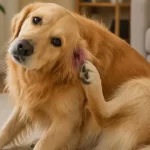
Changes in activity level show up as a reduced interest in walks, play, or previously loved toys. Many dogs with CCD begin pacing aimlessly or engaging in repetitive behaviors like licking one spot on their body over and over. Some simply wander from room to room without settling.
Finally, anxiety tends to spike. Dogs may become frightened of everyday sounds they once ignored, develop phobias around thunderstorms, or panic when left home alone — even briefly. This heightened anxiety reflects how overwhelming a confused, unpredictable world feels to a dog whose mental map is crumbling.

How Common Is It, Really?
The numbers are more sobering than most owners expect. Research shows that 28% of dogs aged 11 to 12 already display at least one sign of cognitive decline. That figure climbs sharply with age: by the time a dog reaches 15 or 16 years old, roughly 68% of dogs show measurable symptoms of CCD. A small percentage of dogs begin showing signs as young as six or seven, which is why age alone is not a reliable boundary.
Dogs of every breed can develop CCD, but research suggests some breeds may be more susceptible than others. Smaller breeds tend to live longer overall, which means they may show signs of cognitive decline later but live with the condition for longer. Larger breeds often have shorter lifespans but can develop CCD at younger ages.
When Confusion Is Something Else Entirely
Here is the critical point many owners miss: the symptoms of CCD overlap significantly with other medical conditions. Pain from arthritis can make a dog restless and unwilling to lie down, mimicking pacing behavior. A urinary tract infection or bladder stones cause housetraining accidents. Kidney disease, liver disease, and thyroid problems can all produce confusion and behavioral changes that look just like dementia.
Before assuming your dog has CCD, a veterinary visit is essential. Your vet will run blood work, possibly take X-rays, and assess whether pain or an underlying illness better explains what you are seeing. In some cases, a CT scan may be recommended to rule out brain tumors or other neurological abnormalities.
Your vet may also use a tool called the Canine Cognitive Dysfunction Scale, or CADES, to measure how severe your dog’s symptoms are. This gives you an objective baseline and helps track whether the condition is improving, stable, or worsening over time.
What You Can Actually Do to Help

There is no cure for CCD — the brain changes that occur cannot be reversed. But the progression can be slowed, and your dog’s quality of life can be meaningfully improved with the right combination of strategies.
Environmental adjustments make a significant difference right away. Night lights help enormously for dogs who become confused after dark, because declining vision combined with cognitive confusion turns every late-night walk into a frightening experience. Keep your dog in a smaller, more manageable space at night — a room where she cannot get lost behind furniture or stuck in corners. Some owners find that a comfortable, enclosed crate reduces anxiety and gives your dog a safe anchor point.
Consistency and routine matter more than ever. Try to keep feeding times, walk schedules, and bedtime as predictable as possible. When you need to change something — a new work schedule, a move, a visitor — introduce the change as gradually as you can. Senior dogs with CCD adjust to new information much more slowly than they once did.
On the nutrition side, several supplements and therapeutic diets have shown promise in supporting aging brains. Omega-3 fatty acids, particularly DHA and EPA, support neuron health. Antioxidants combat the oxidative damage that contributes to cognitive decline. Some veterinarians recommend specific prescription diets formulated for senior brain health, which combine multiple supportive nutrients in the right proportions.
Mental stimulation keeps the neural pathways as strong as possible for as long as possible. Simple games, gentle training with small rewards, and even just sniffing walks instead of rushed exercise walks give the brain valuable work. Keeping your dog socially engaged — without overwhelming a stressed or anxious animal — also helps.
In more advanced cases, your veterinarian may discuss medications that support brain chemistry. These do not cure CCD, but they can reduce anxiety, improve sleep quality, and help some dogs feel more present and comfortable day to day.
What the Future Looks Like
CCD is a progressive condition, which means it will worsen over time. The pace varies enormously from dog to dog. Some animals show very slow progression over several years; others decline more quickly. The goal of treatment is not to stop the disease — current medicine cannot do that — but to slow it down and keep your dog feeling safe, comfortable, and as connected to you as possible for as long as possible.
Owners who catch the early signs and seek veterinary guidance early tend to have the best outcomes. The sooner you understand what is happening, the sooner you can start making the small environmental and dietary changes that add up to a much better life for your dog.
If your senior dog has been acting strangely, do not wait to see if it passes. It will not — but the right support can make the months and years ahead far better than they would be otherwise. Your dog spent her whole life remembering you. She deserves the same from you now, when remembering is the hardest thing she has to do.