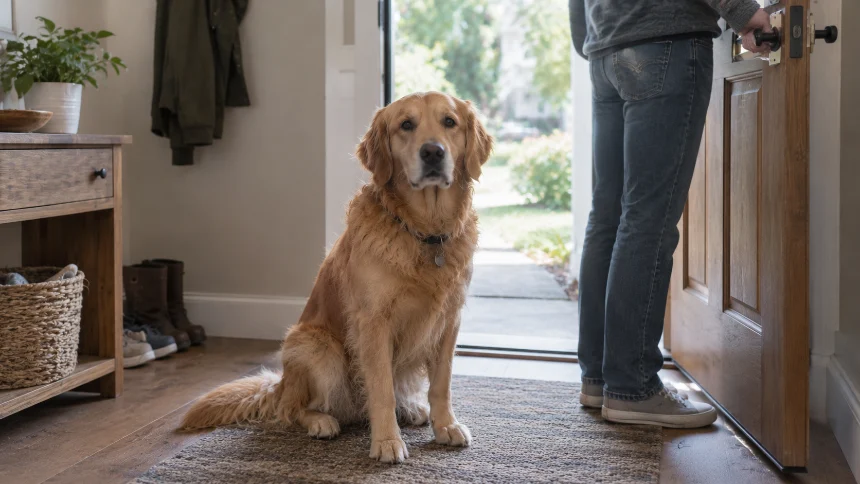
The moment you reach for the front door, your dog rushes forward. As soon as the handle moves, it tries to squeeze through the opening, pulling you along or nearly knocking someone over.
This behavior can be stressful, especially when you are carrying groceries, welcoming visitors, or trying to keep your dog safely inside. The solution is not simply to shout “stay” louder. Your dog needs to learn what to do while the door opens—and that waiting is more rewarding than rushing ahead.
With short, consistent sessions, you can teach a useful door-waiting routine that makes everyday departures safer and calmer.

1. Why Dogs Rush Through Open Doors
For many dogs, an open door predicts something exciting: a walk, a chance to explore, a visitor, or access to the garden. When rushing forward has worked before, the behavior can become a habit.
Dogs do not automatically understand that an open doorway is a boundary they should respect. If they have repeatedly reached the outside by moving quickly, they may have learned that speed gets results.
Excitement is not the only possible reason. Some dogs rush because they are anxious, startled by visitors, or eager to get away from something indoors. Watch your dog’s body language and consider the situation rather than assuming every dog is simply being disobedient.
The goal is to build a predictable routine: pause, wait for the door to open, and move forward when given permission.
2. Set Up a Safe Training Space
Start when you are not in a hurry to leave. Choose a quiet time with few distractions, and keep your dog on a leash if there is any risk of it slipping outside.
Use a secure door or interior barrier that prevents an accidental escape. A baby gate or exercise pen can provide an extra layer of safety while your dog learns.
Have a few small treats ready. They should be easy to deliver quickly, and your dog should be comfortable eating them in the training area.
Before practicing at the front door, make sure your dog can comfortably pause for a moment in a familiar room. You do not need a perfect stay cue, but a simple sit or brief pause can make the first steps easier.
3. Teach the Door-Waiting Routine Step by Step
Step 1: Reward a pause before touching the handle
Stand a short distance from the closed door with your dog on the inside. When your dog pauses instead of pushing forward, mark the moment with a calm “yes” and give a treat.
If your dog already knows a sit, you can ask for it. However, the important skill is waiting calmly, not holding one specific body position at all costs.
Step 2: Reach toward the handle
Once your dog can pause near the door, move your hand toward the handle. Reward your dog if it remains in place.
If the movement makes your dog surge forward, stop and make the exercise easier. You might move your hand only halfway toward the handle before rewarding the pause.
Step 3: Turn the handle without opening the door
Practice turning the handle while the door stays closed. Reward your dog for remaining behind the threshold.
Repeat until the handle movement no longer causes an immediate rush. Keep the tone relaxed and avoid repeating cues rapidly.
Step 4: Open the door a tiny amount
Open the door just an inch or two, then close it again before your dog moves forward. Reward the pause.
If your dog starts to rush, calmly close the door if it is safe to do so, then try again with a smaller opening or less movement. Do not slam the door or use it to frighten your dog.
Step 5: Gradually open the door wider
As your dog becomes more successful, open the door a little farther and wait briefly. Build up in small increments rather than expecting your dog to cope with a fully open doorway immediately.
Keep the leash attached during early practice, especially if the door opens directly onto a road, shared hallway, or other unsafe area.
4. Add a Release Cue
A release cue tells your dog when waiting is finished. Choose a simple word such as “okay” or “let’s go,” and use it consistently.
Once your dog can wait while the door opens slightly, say the release cue and invite it forward. Reward the dog for moving through calmly rather than lunging.
At first, release your dog after only a second or two of waiting. Gradually increase the time as the behavior becomes more reliable.
If your dog moves forward before the release cue, gently reset the exercise. Make the next attempt easier, reward sooner, or reduce how far the door opens. Avoid turning the lesson into a repeated battle over the threshold.
5. Practice With Real-Life Distractions
Waiting in a quiet room is easier than waiting when a visitor rings the bell or another dog passes outside. Introduce these distractions one at a time after your dog understands the basic routine.
- Before a walk: Practice the pause before attaching the leash or opening the door.
- When someone arrives: Start with a familiar helper who can stand quietly outside while you reward your dog indoors.
- When carrying items: Practice with a light bag only after your dog can wait reliably during easier sessions.
- At a garden gate: Teach the same pause-and-release routine at a secure gate, using a leash until the behavior is dependable.
Do not ask your dog to handle every distraction at once. A visitor, a ringing bell, a moving door, and an exciting walk can be too much for a beginner.
If your dog becomes frightened or intensely reactive when someone approaches the door, prioritize distance and safety. A separate room or secure barrier may be more appropriate while you work on the underlying emotion.

6. Common Mistakes to Avoid
Opening the door too far, too soon
A wide-open doorway can be extremely difficult for a dog that has not learned to wait. Start with tiny movements and increase the challenge gradually.
Repeating “stay” over and over
Repeated cues may become background noise. Give a cue once if needed, then adjust the exercise so your dog has a realistic chance to succeed.
Rewarding only long waits
Short pauses are valuable early successes. Reward them before your dog gets frustrated, then gradually build duration.
Relying on training instead of physical safety
Even a well-trained dog can react unexpectedly to a squirrel, loud noise, or sudden movement. Use a leash, secure gate, or other appropriate barrier whenever an escape could put your dog or others at risk.
Practicing only when you are in a hurry
Rushed departures make it harder to teach a new behavior. Practice when you have time to repeat a few easy steps without pressure.
7. How Long Does It Take?
Some dogs understand the basic routine within a few sessions, while others need repeated practice over several weeks. Progress depends on the dog’s history, excitement level, environment, and how consistently the routine is used.
Start with two or three short sessions a day, each lasting only a few minutes. Stop while your dog is still succeeding rather than pushing until it becomes frustrated.
Look for gradual improvements: your dog pauses when you approach the door, stays behind the threshold as it opens, and waits for the release cue more often. If the behavior falls apart in a new situation, return to an easier version and build up again.
Most importantly, keep using physical safety measures while the skill develops. A doorway is not a good place to test whether your dog has learned a lesson when an accidental escape could be dangerous.
Teaching your dog to wait at the door is not about demanding perfect obedience. It is about building a clear, repeatable habit that gives your dog a safe way to handle excitement. With patient practice, opening the door can become a cue to pause rather than a signal to rush.